How much should a cotton pillow weigh, by size?
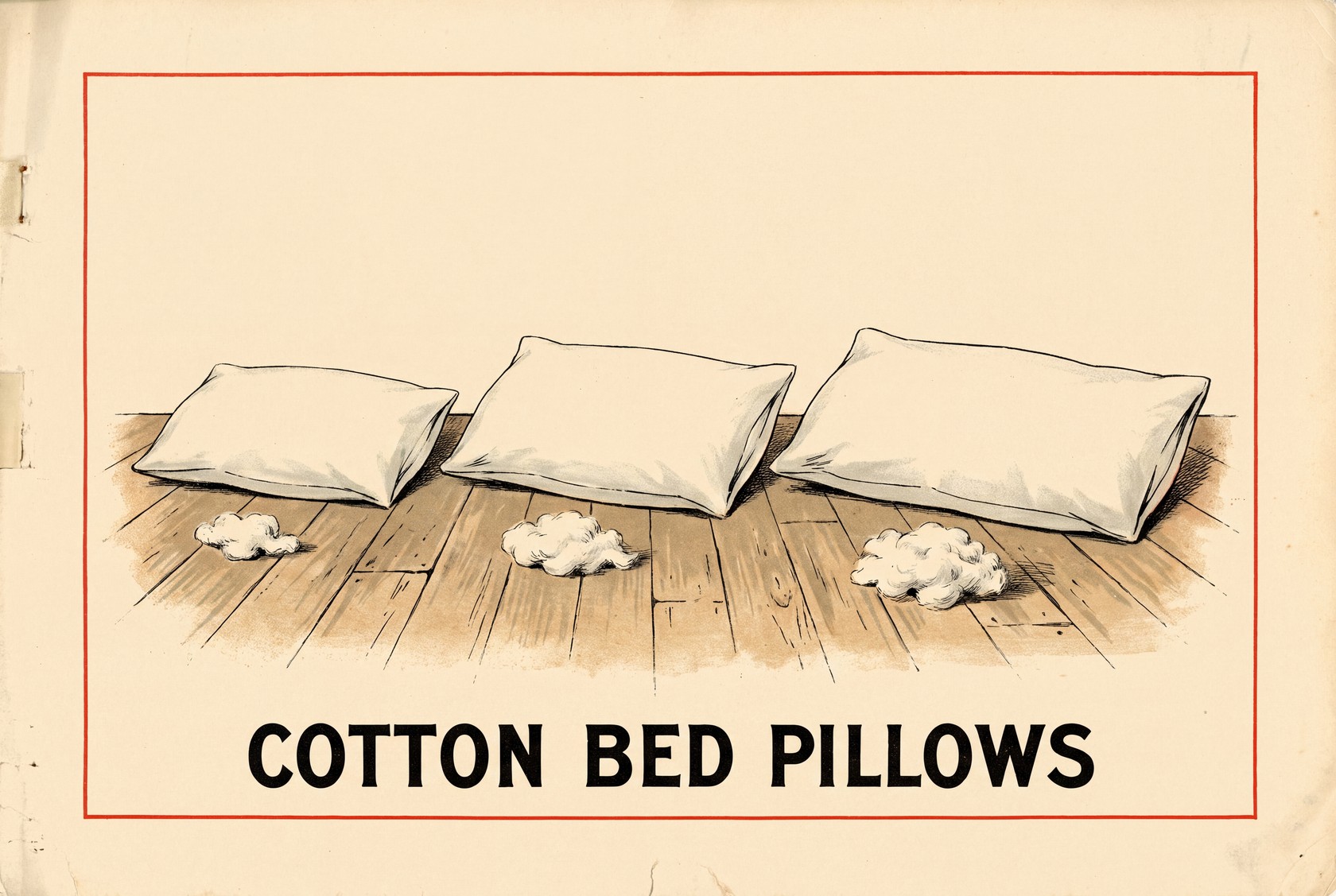
A cotton-filled pillow is heavy for its size. The weight on the product page is the quickest clue to how full it is, yet most sellers leave that number off. This page collects the figures sellers do publish, scales them across standard, queen and king, and shows you how to check what arrives.
Short answer: A cotton standard pillow usually holds about 2 to 4 pounds of cotton fill. One maker's chart puts its soft standard in the lower part of that range and its firm standard at the top, with queen and king sizes heavier in step with their extra length (Rawganique). Sachi's standard sits at the low end. If a cotton standard lists much less, ask whether that figure covers the fill alone or the whole pillow.
This guide is for: people choosing a cotton-filled bed pillow in a US standard, queen or king size who want to judge whether the stated weight is fair.
Key Takeaways
Three figures carry most of this page: what a standard weighs, how queen and king scale from it, and why the label can mislead.
- A cotton standard holds about 2 to 4 lb of fill. Sachi's standard sits at the low end of that range (Natural Linens), and Rawganique's soft and firm grades span most of it (Rawganique).
- A king needs nearly 40% more fill than a standard to feel the same. Its face is that much larger by area, and one maker's soft king matches its soft standard scaled up by area almost exactly.
- 6 of the 10 cotton pillow pages we read gave no fill weight in their text. Only 1 listed a weight for every size and grade, so asking the seller is often the only way you will find out what is inside.
Each figure is explained, with its source, in the section below that covers it. Where a number is our own arithmetic, the section says so and shows the method.
On This Page
Eight questions, running from what each size weighs to how you can check a new pillow at home on an ordinary bathroom scale.
How much does a cotton pillow weigh in each US size?
A cotton standard is heavy next to a synthetic one, and the queen and king add weight roughly in step with their extra area.
US bed pillows share one width and differ in length. The Futon Shop sells its organic cotton pillow in standard, queen and king (The Futon Shop), and Sachi Organics lists the same three sizes (Sachi Organics). A standard measures 20 by 26 inches, a queen 20 by 30, and a king 20 by 36. A queen is a longer standard, not a thicker one.
The fullest chart we found is Rawganique's. It gives a weight for each size at 3 grades it calls soft, medium and firm. Sellers often call this "loft"; this page says height, because height is what the extra cotton buys you. The page labels its figures as fill weights, which means the cotton alone. The table below keeps the two ends of its range.
Cotton fill by size at the soft and firm grades, from one maker's published chart (Rawganique)
| Size | Soft | Firm |
|---|---|---|
| Standard | 2.7 lb | 4 lb |
| Queen | 2.9 lb | 4.4 lb |
| King | 3.7 lb | 5.5 lb |
Read across and weight climbs with firmness; read down and it climbs with length. The medium grade falls between the two columns at every size. One chart is not an industry standard, so treat these figures as a reference point rather than a rule. Other makers start lower. Sachi's cotton standard sits below this chart's soft grade (Natural Linens). Taken together, the published figures put a cotton standard in the 2 to 4 lb range, with Sachi at the bottom and this chart's firm grade at the top.
What did we find when we counted sellers' published weights?
Most cotton pillow pages we read gave no fill weight at all, and only one listed a weight for every size and firmness it sold.
We read 10 US product pages for cotton-filled bed pillows on September 26, 2026, and sorted each one by what its text says about fill weight. We counted statements on pages, nothing more, and three buckets came out.
What the pages state about weight (our count)
| What the page states | Pages | Which pages |
|---|---|---|
| A fill weight for every size and grade | 1 | Rawganique |
| One weight only, or a minimum | 3 | Cece's Wool, Natural Linens (Sachi), SleppyCo |
| No weight in the text we read | 6 | Sachi Organics, The Futon Shop, Pure Living Space, Organic Textiles, My Organic Sleep, Magnolia Organics |
The pages in the last bucket were Sachi Organics, The Futon Shop, Pure Living Space, Organic Textiles, My Organic Sleep and Magnolia Organics.
A single weight on a page helps you less than it looks, because you cannot always tell what it measures. Cece's Wool promises a minimum amount of batting, which is a floor rather than a figure per size. SleppyCo gives one approximate weight for its standard, which reads as the finished pillow. Some pages in the last bucket may show weight in an image or a size menu that page text does not carry. So the fair reading of that bucket is "not stated in text," not "never stated." Either way, you end up buying most of these pillows without the one number that tells you whether your head will rest on a thin standard or a full one.
Why is a cotton pillow heavier than a polyester or wool one?
Cotton batting packs down under a head and stays packed, so makers put in more of it to hold a useful height through the night.
Cotton fill settles. Makers plan around that. Lifekind notes that cotton fillings compress by about half over time, and advises ordering one grade fuller than you expect (Lifekind). To keep a useful height after that settling, a cotton pillow starts with more fiber than a pillow of the same size filled with something springier. The form of the cotton matters too. Our guide to batting and shredded cotton fill covers how each one behaves over time.
The other natural fills we found sit well below cotton. Rawganique's kapok standard is lighter than its cotton standard at both the soft and firm ends of its range (Rawganique). Frankenmuth's standard wool pillow holds less fill than even the lightest cotton standard in the chart above (Frankenmuth Woolen Mill). We found no polyester page whose fill weight we could check, so this page leaves synthetic figures out rather than guess at them.
The extra weight in a cotton pillow is not padding; it is the reserve of fiber that keeps your head up once the batting settles. A cotton pillow that feels heavy when you lift it out of the box is doing what its fill requires.
Does the stated weight mean the fill or the whole pillow?
Sellers use both, often without saying which, and a cover plus zipper means two pillows with the same number can hold different amounts of fill.
Two kinds of number sit on pillow pages, and they are easy to mix up. A fill weight counts only the cotton inside. Rawganique labels its figures as fill weights, and Sachi describes its standard as filled with a stated weight of cotton (Natural Linens). A product weight counts the cotton plus the case, piping and any zipper. SleppyCo describes its cotton standard by an approximate overall weight (SleppyCo), which is the finished pillow.
So two pillows showing the same weight may not hold the same cotton. Rawganique's soft standard and SleppyCo's standard list the same figure, yet one is fill alone and the other includes the case. The finished pillow holds less cotton once you take the case off. None of the pages we read said what its case weighs, so you cannot subtract it with confidence.
When a page does not say "fill," assume the number includes the case and ask the seller. Shipping weights are a third number again, often padded by packaging, so set them aside.
Zipper pillows add a twist. Rawganique notes the zipper lets you adjust the fill as needed, and suggests uses for the excess (Rawganique). Ask whether the listed weight is what ships or what a typical person keeps after taking some out.
How much fill should a queen or king have compared with a standard?
Scale by face area so your head sits at the same height: a queen needs about a sixth more fill than a standard, and a king about two fifths more.
All three sizes share one width, so the fair comparison is face area, which is length times width. A standard's face is 520 square inches, a queen's 600 and a king's 720. That makes a queen's face about 15% larger than a standard's, and a king's about 38% larger. For the same feel, add fill in the same proportion as the face grows.
How much more fill each size needs than a standard (our arithmetic from face area)
| Size | Face compared with a standard | Fill for the same height |
|---|---|---|
| Standard | Same | Same |
| Queen | About a sixth larger | About a sixth more |
| King | Nearly two fifths larger | Nearly two fifths more |
Method: length times width for each size, each divided by the standard's face. No maker publishes these ratios.
Rawganique's chart follows this rule closely for its king. Its soft king sits within a tenth of a pound of what the area rule predicts. The queen runs lighter. Its firm grade lists 4.4 lb against the 4.6 lb the area rule predicts, so on paper it sits a touch lower than the standard and king at the same grade. If you are moving from a standard to a queen and want the same height, keep any spare fill a zipper model ships with.
What weight should you pick for the way you sleep?
Weight is a stand-in for height. People who sleep on their side need the most, stomach sleepers the least, and back sleepers fall between.
Weight matters because it sets height. Height is what your neck feels. The research offers a range, not a single number. In a study of side sleepers, a medium, individually fitted pillow height with neck support kept the neck curve closest to its natural standing shape (Medical & Biological Engineering & Computing). That medium height works out to roughly four to four and a half inches. A review was blunter: there remain no firm conclusions about the optimal pillow height for the supine and lateral positions (PMC review).
No maker we read turns weight into a sleeping-position guide, so the table below is our judgement, built from the charts above. The published range it refers to runs from Sachi's baseline at the bottom to Rawganique's firm standard at the top.
What a standard's cotton fill weight suggests (our judgement)
| Standard fill weight | What it suggests | Often suits |
|---|---|---|
| Below the lightest cotton standard we found | May be a blend or a finished-pillow figure | Ask before buying |
| Lower half of the published range | Soft to medium | People who sleep face down, or on their back with a slim build |
| Upper half of the published range | Medium to firm | People who sleep on their back or side |
| Above the firmest standard grade we found | Very full | People with broad shoulders who sleep on their side |
For a queen or king, scale these bands by the area factors in the previous section. A zipper matters more than the exact starting weight, because it lets you take cotton out until your head sits level.
Does a cotton pillow lose weight or just height over time?
It keeps its weight and loses height. The fibers stay inside the case but pack tighter, which is why a zipper and spare fill matter.
The cotton stays in the case. It just packs tighter. Lifekind says cotton fillings compress by about half over time (Lifekind). A pillow can keep all its weight while losing much of its height. Sachi publishes the height of its standard at the center and at each end when new (Natural Linens). The published figures do not say where it ends up.
Height change is not trivial. In one lab study, pillows ran from roughly four to seven inches high, and average pressure on the back of the head was clearly higher at the tallest than at the lowest (PMC). A pillow that settles by an inch or two is, in effect, a different pillow from the one you chose by weight.
That is why the starting weight works partly as a buffer. Sachi sells refill material by the half pound and says that amount is typically enough to restore a standard pillow (Sachi Organics). Our guide on why cotton pillows flatten covers which part of the loss you can reverse and which part you cannot.
How do you check a pillow's weight before and after buying?
Before buying, ask the seller two questions. After it arrives, a bathroom scale and a few minutes tell you whether the fill matches the page.
Before you pay, put 2 questions to the seller. First, is the listed weight the cotton fill or the finished pillow? Second, on a zipper model, does that figure include spare fill you are meant to remove? Clear answers to both tell you what the number on the page means. For a queen or king, apply the area factors from earlier before deciding whether a figure looks light.
A bathroom scale is enough once it arrives. Step on holding the pillow, step on without it, and take the difference. Home scales are coarse, so round the result to the nearest half pound and compare it with the page. Remember the case adds a little, so the total should come out above the stated fill, never well below it. If the total comes in below the fill weight the seller quoted, send the seller a message.
If you are still choosing, our checklist for buying an organic cotton pillow covers certification and cover fabric alongside fill. Keep the seller's answers in writing, because the original fill weight is your reference when you top the pillow up later. You will want that number in a year's time.
Common questions
Short answers to the questions that come up around cotton pillow weight, each one written to stand on its own if someone quotes it.
How much does a standard cotton pillow weigh?
Usually 2 to 4 lb of cotton fill. Rawganique's soft and firm standards span most of that range (Rawganique), and Sachi's standard sits at its low end (Natural Linens).
How much does a king cotton pillow weigh?
Rawganique's cotton king is the heaviest size in its chart at every grade (Rawganique). As a rule of thumb, a king needs nearly two fifths more fill than a standard to feel the same.
Is a heavier cotton pillow better?
Not by itself, because more cotton simply means more height and firmness, and researchers have reached no firm conclusions about optimal pillow height (PMC review). Pick a weight that suits how you sleep, and prefer a zipper so you can adjust it.
Why does my cotton pillow feel flatter but weigh the same?
The fiber compacts rather than leaving. Cotton fillings compress by about half over time (Lifekind), so height falls while weight stays put.
How much cotton does it take to refill a pillow?
Sachi sells refill by the half pound and says that amount is typically enough for a standard pillow (Sachi Organics). Scale up by area for a queen or king.
Do wool and kapok pillows weigh less than cotton?
Generally yes at the same size, going by the pages we read. Frankenmuth's standard wool pillow holds less fill than any cotton standard we found (Frankenmuth Woolen Mill), and Rawganique's kapok standard is lighter than its cotton standard at both ends of its range (Rawganique).