Is batting or shredded cotton fill better on night one and night three hundred?
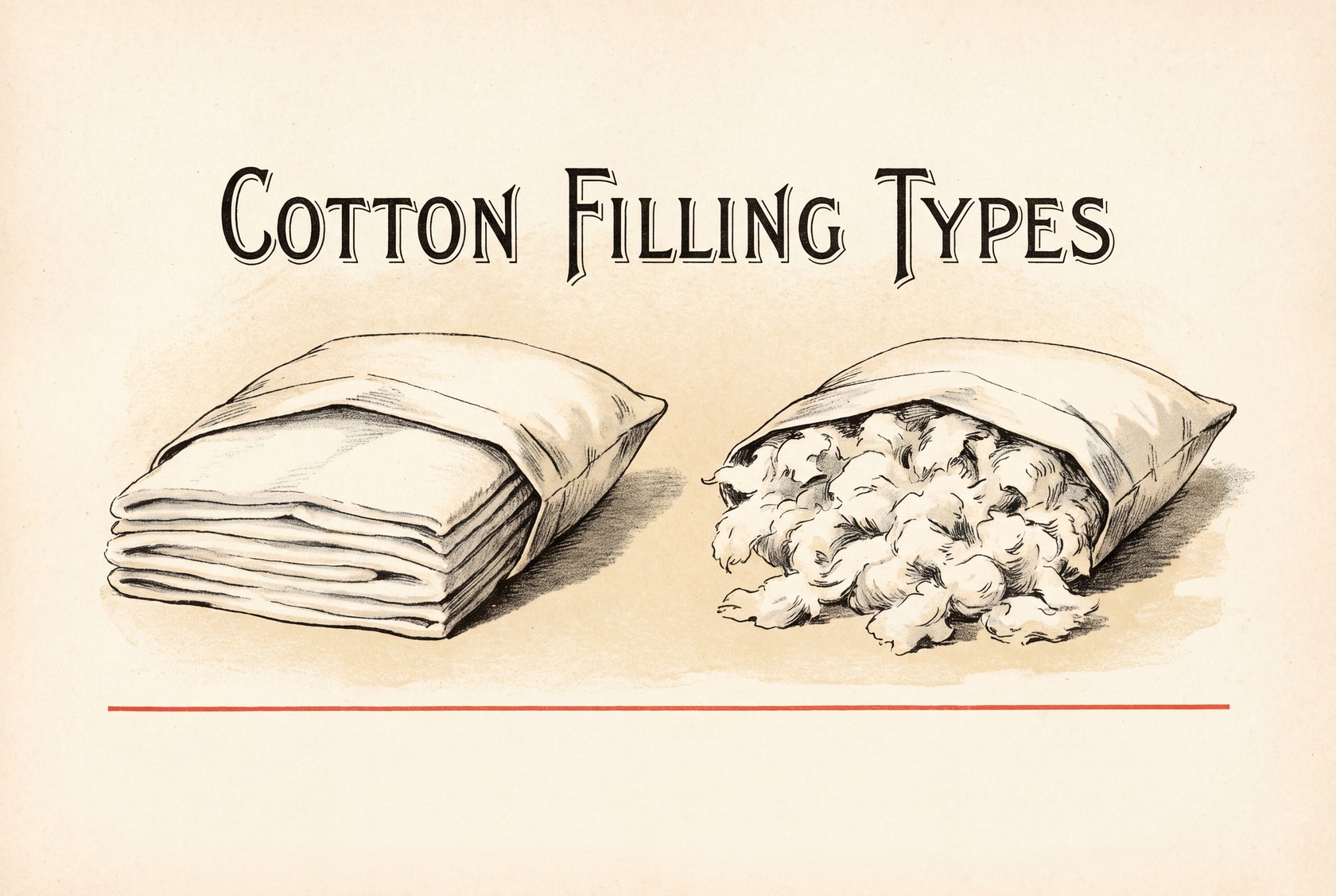
Two cotton pillows can carry identical labels and feel nothing alike. One is built from carded sheets of cotton batting laid in layers, and the other is packed with loose, torn tufts of cotton. Most people notice the difference the first time they lie down. They notice it again, and more sharply, after most of a year of a head pressing into one spot.
Short answer: Batting feels flatter, firmer and more even on night one. Loose shredded cotton feels softer and lets a sleeper press a hollow for the head. By night three hundred both have packed down, and one seller of batting pillows says the fill can condense to about half its original volume (Cece's Wool). Either form wears out, and the form you pick changes how. A zipper and careful drying matter more than the shape of the fill.
This guide is for: people choosing between cotton pillows who want to know how the fill will feel on the first night and how it will hold up after a year.
Key Takeaways
Three points carry most of this page: how each fill feels at first, how much it packs down, and why drying decides its life.
- Batting and loose cotton feel different from night 1. Batting gives a flat, even, fairly firm surface, while loose tufts are softer and can be pushed into a hollow that supports the head and neck.
- By night 300, either form may have packed down a long way. One seller says cotton batting can condense to about half its original volume (Cece's Wool), so a zipper that allows adding fill matters more than the shape of the fill.
- Textile engineers list cotton's moisture regain at 8.5%, against 0.4% for polyester (ACS ChemMatters). Cotton holds far more water, so drying the fill all the way through after a wash decides whether either form lasts.
Each point has its own section below. Every figure links to the page where it was found, so you can check it yourself.
On This Page
Eight questions, in the order people tend to ask them, from what the two fills are to which one suits the way you sleep at night.
The first 2 sections explain what the two fills are and report what sellers say about them. The middle 3 follow a pillow from the first night through a year of use. The last 3 cover adjusting, washing and choosing, and the common questions close the page.
What is the difference between cotton batting and shredded cotton fill?
Batting is cotton carded into flat sheets and layered; shredded fill is loose tufts. Same fiber, different shape inside the case.
Batting is cotton fiber carded into a thin, continuous sheet, then cut and stacked or rolled to fill a case. Carding combs the fibers so they lie mostly one way and hold together as a web. One seller describes its pillow as hand-stuffed with layers of organic cotton (Pure Living Space), which is the classic batting build. Shredded or loose fill is cotton fiber broken into small, separate tufts that tumble past each other. Our explainer on what cotton fill is covers the fiber itself.
The words on a product page do not always follow this split. One seller calls its craft fill "Stuffing/Batting" but sells it as a bag of loose fiber that does not come in sheets (Organic Cotton Plus). So the word "batting" does not guarantee layers. Look for a photo of the open pillow, or ask the seller how the fill goes in.
| Batting | Shredded or loose cotton | |
|---|---|---|
| Shape inside the case | Flat sheets, stacked or rolled | Small separate tufts |
| How the fibers lie | Combed, mostly one direction | Tangled, every direction |
| Words a page may use | Batting, layers, hand-stuffed | Loose fill, stuffing, sometimes batting |
| What you can change | Whole layers | A handful at a time |
What do sellers' product pages say about their cotton fill?
Of six cotton pillow pages we read, half said batting, half named cotton without a form, and none described shredded cotton.
We read 6 seller product pages for cotton-filled bed pillows on September 26, 2026, and sorted each one by how it describes the form of the cotton inside. Every entry below comes from the wording on the page itself. Nothing here was handled, weighed or slept on.
| What the page says about the fill | Pages | Which pages |
|---|---|---|
| Names batting or layers | 3 | Cece's Wool, Pure Living Space, Sachi Organics |
| Names cotton but not its form | 3 | OrganicTextiles, Magnolia Organics, Organic Cotton Plus pillow forms |
| Describes shredded or loose cotton | 0 | None |
The zero is the finding. Sellers use "shredded" freely for foam fills, yet none of these cotton pages used it, so anyone who wants loose cotton will usually have to ask. Only one page gave a fill weight, stating at least 2 pounds of cotton batting in each pillow (Cece's Wool). That figure helps with comparison, because 2 pillows of equal size can hold very different amounts of fiber.
When a page leaves the form out, send the seller 2 questions before you buy. Is the cotton laid in as sheets or packed as loose tufts? Can you open the case to add or remove fill? A seller who answers both plainly is telling you how the pillow will age.
How does each fill feel on the first night?
On the first night batting feels flat, even and firm, while loose tufts feel softer and let you push a hollow for your head.
On night one, batting feels flat, even and firmer than many people expect. One seller of batting pillows calls its own product a dense pillow and steers people who want something softer toward kapok (Pure Living Space). Loose tufts give way more at first. Because the pieces slide past each other, a sleeper can push them toward the neck edge or press a hollow for the head. Our judgement, from how the two forms are built, is that loose cotton feels softer on the first night and batting feels more uniform.
The height printed on a listing can mislead you here. One review team grades height on the pillow's thickness when it is not compressed (Sleep Foundation), but a head rests on the compressed height. One fiberfill test method puts the fill in a 20 by 26 inch cotton ticking and presses it with a 10 pound load, a figure that "approximates the load applied to a pillow under conditions of actual use" (USPTO patent 6,872,352).
The first minutes also count. In a laboratory trial, people who sleep on their side rested on each test pillow for 10 minutes while researchers tracked the angle of the neck (Journal of Multidisciplinary Healthcare). Neck angle shifted significantly when people moved between a feather pillow and the other fills tested. Cotton was not tested, so take the general lesson: the way the fill behaves under your head sets your neck angle, whatever the label says.
What happens to cotton fill after months of use?
Both forms pack down with use. Batting tends to become a thin flat mat, and loose tufts tend to drift into lumps at the edges.
Both forms pack down with use, and seller pages say so openly. One maker of batting pillows says cotton batting can condense over time to about half of its original volume (Cece's Wool). Another says natural fiber pillows will compress over time but stay comfortable (Sachi Organics). Neither gives a number of nights. Treat "night three hundred" as a rough marker for most of a year of use, since no page measures it.
What differs is the way each form wears out. The table is our judgement from the construction; no maker publishes it.
| Batting | Loose shredded cotton | |
|---|---|---|
| Night one | Flat, even, fairly firm | Softer, easy to shape |
| After a few weeks | Settles, surface stays even | Tufts drift toward the edges |
| Night three hundred | Thinner, denser mat, firm and low | Firm clumps with thin spots between |
| What brings it back | A fresh layer of batting | Teasing clumps apart, then topping up |
| Main risk | Too low under your head | Uneven support across the pillow |
Batting keeps its layers roughly in place, so it tends to lose height evenly across the whole pillow. Loose tufts move, which feels good on the first night and less good once they gather in the corners. For people who sleep on their side, lost height hurts most, because the pillow has to fill the gap between ear and shoulder.
Why does cotton fill flatten and clump over time?
Cotton fibers soak up moisture from breath and sweat, soften, and settle slowly under the weight of your head, night after night.
Cotton is a thirsty fiber. Textile engineers measure this as moisture regain, the water a fiber holds as a share of its dry weight, and they list cotton at 8.5%, wool at 16% and polyester at only 0.4% (ACS ChemMatters). A pillow sits under a sleeper's breath and skin for hours every night, so the fill takes up moisture during sleep. Our explanation, drawn from how fiber behaves since no pillow study covers it, is that damp cotton softens and packs more easily under the steady weight of your head.
Each form then fails in its own way. Batting was combed into a sheet, so its fibers resist knotting, but the sheet itself grows thinner and denser. Loose tufts rub against each other every time a sleeper turns over, and over months they tangle into small knots that will not spring back unless you pull them apart by hand.
Research on pillows in daily use supports the wider point that fill matters. In a blinded field trial of people who sleep on their side, researchers recorded waking stiffness, headache and shoulder-blade pain every day (Journal of Pain Research, via PubMed). A companion trial enrolled 106 side sleepers, who spent a week on each of 5 trial pillows: polyester, foam, feather, rubber and a foam contour shape (Manual Therapy, via PubMed). Cotton was not among the fills. Both studies treat fill type as something that changes how people wake up, which is why a year of packing down matters.
Which cotton fill is easier to adjust and top up?
Loose tufts are easier to add, remove and tease apart by hand. Batting adjusts in whole layers, which is coarser but tidier.
Loose fill adjusts in small steps, and batting adjusts in whole layers. Adjusting loose tufts means opening the zipper, pulling out a handful or pushing one in, and fluffing the rest. With batting you add or lift out a layer, which changes height in bigger jumps but leaves the surface smooth.
A zipper is what makes either form adjustable. One batting pillow page says its zipper allows adjusting the fill and adding more later (Cece's Wool). Another cotton pillow page tells buyers to open the zipper and remove fill until the firmness feels right (Magnolia Organics). A sewn-shut cotton pillow gives you none of this. Once it packs down, you keep whatever height is left.
Top-up fill comes in modest amounts. One seller's refill holds about 4 ounces, or 10% of the original filling, whichever is more (OrganicTextiles). Loose organic cotton for stuffing is sold by weight in 1 pound bags, and the seller advises wearing a dust mask when you handle it (Organic Cotton Plus). Our checklist for zippered pillows is in What should you check before buying an organic cotton pillow?
How do you wash and dry a cotton-filled pillow without ruining it?
The wash itself rarely ruins cotton fill. Drying does: fill left damp in the middle mats into hard clumps that do not come apart.
Drying is the step that decides whether cotton fill survives a wash. Cotton takes up water readily, and a thick core dries from the outside in. If the center stays damp, the fibers mat together and the clump sets as it dries. Follow the maker's care instructions first, since some makers of natural-fill pillows say the fill should be spot cleaned only (Naturepedic).
Many zippered designs allow washing the case on its own. One seller of zippered cotton shells tells you to remove any inner material before washing and to dry the shell on low heat (Cece's Wool). That habit spares the fill most washes.
When the fill itself needs cleaning and the maker allows it, these steps help with either form:
- Open the zipper so air can reach the middle of the fill while it dries.
- Spread loose tufts out on a clean towel, and pull apart any clumps while they are still damp.
- Dry batting layers flat and turn them, because the center of a thick layer dries last.
- Squeeze a handful from the middle before you close the case, and if it feels cool, leave it to dry longer.
- Air the pillow in daylight on a dry day, and wait until the next day to zip it up.
Zipping a damp pillow closed is a quick way to turn soft cotton into hard lumps.
Which fill should you choose for how you sleep?
Pick batting if you want a steady, even surface. Pick loose tufts if you reshape your pillow often. Insist on a zipper either way.
Start with the way you lie and how often you move in the night. People who sleep on their side need the most height under load, and batting holds an even height across the pillow for longer before it thins. People who sleep on their stomach usually want a low pillow, and loose tufts make it easy to pull out enough fill to get there. People who change position through the night may prefer loose fill, because it can be shaped with a lower middle for lying on the back and higher sides for turning, the way sellers of other loose fills describe (Organic and Healthy).
Whatever you pick, 3 checks matter more than the form of the cotton:
- a zipper that opens the whole fill chamber
- a stated fill weight, or at least a stated form of cotton
- a way to buy more fill later
If you want a fiber pillow that resists clumping more than cotton does, some makers shape wool into small balls for that reason (Naturepedic). Whether cotton suits you at all is a separate question, covered in our guide on whether a cotton pillow is worth buying.
Common questions
Short answers to the questions people ask most often about cotton fill, each one kept brief enough to read on a phone before you buy.
Is cotton batting the same thing as cotton stuffing?
Not always. Batting usually means carded sheets, but some sellers use the word for loose fiber sold by the bag, so check a photo of the open pillow or ask how the fill is laid in.
Does shredded cotton fill get lumpy over time?
It can. Loose tufts drift and knot with use, especially when they stay damp, but the case can be opened, the clumps teased apart by hand and fresh fill added.
How long before a cotton pillow starts to feel flat?
Sellers do not give a number of nights. One batting maker says the fill can condense to about half its first volume over time, so plan on adding fill during the first year.
Can you turn a batting pillow into a loose-fill one?
Batting can be pulled apart into tufts by hand, but the result is uneven and dusty. It is simpler to buy loose fill for the purpose and leave the layers whole.
Is a firmer cotton pillow better for neck pain?
The evidence does not say. Trials show that fill type changes neck angle, but cotton was not among the fills tested, so choose by the height under your head and adjust from there.
Does organic cotton change how the fill ages?
Organic describes how the cotton was grown and processed. It says nothing about the shape of the fill, so organic and conventional batting pack down alike, and the form of the fill and your drying habits decide the rest.