Answer first
Sellers squeeze the air out because carriers bill bulky parcels by box size. By our arithmetic, a 2 lb pillow boxed at full height bills like a 29 lb parcel (Golocad). The vacuum bends cotton fibers without breaking them, so most of the height comes back once air flows in again. Expect a flat, creased pillow for the first hours and give it up to three days. The one cotton-fill seller we found that gives a figure says 72 hours (Oregon Fiber Mill).
This guide is for: anyone who has just opened a new cotton pillow, found it flat, creased or lopsided, and wants to know whether it will come back.
Key Takeaways
Three points cover most of what happens between cutting the bag open and sleeping on the pillow, and each one rests on a cited figure.
- Shipping cost is the reason for the vacuum bag. Carriers bill a light, bulky parcel by its size at 139 cubic inches per pound. By our arithmetic, that means a 2 lb cotton pillow boxed at full height bills like a 29 lb parcel (Golocad). Rolled under vacuum, the same pillow bills at about 13 lb.
- Allow up to 72 hours before you judge the height. The one cotton-fill seller in our count that gives a figure says its pillow expands fully within 72 hours (Oregon Fiber Mill). You can sleep on it sooner, but measure it on the third day, not the first evening.
- Of 9 seller pages we read, 5 said nothing about arrival. Only 4 mentioned compression, and 3 of those were cotton covers over fiberfill or microfiber. That means the recovery advice on most vacuum-packed pillows sold as cotton was written for a different fiber.
This page covers only the first few days after unpacking. Flattening over months of use is a different process, covered in why cotton pillows flatten and how much of it you can reverse. If your new pillow also smells when it comes out of the bag, see how long a new cotton pillow smell takes to fade.
Why do cotton pillows ship compressed in plastic?
Carriers charge by box size as well as weight, and a pillow is mostly air, so squeezing the air out is the cheapest way to send one.
A pillow is light for its size, and parcel carriers price that kind of package by the space it fills. UPS, FedEx and USPS turn a box's cubic inches into billed pounds by dividing by 139 and rounding up. They then charge whichever is higher, that figure or the scale weight (Golocad).
A standard cotton pillow weighs about 2 lb. One listing gives 2 pounds of cotton for its standard size (Natural Linens). In a full-height box, you would be paying to ship a lot of air, as the sum below shows. Under vacuum, the same pillow fits a far smaller box.
Sellers give other reasons too. One down seller says its vacuum bag saves space, cuts fuel costs and gets bedding to you faster (Puredown). The sealed plastic is what keeps the fill squeezed, because the pillow stays flat only while no air can get back in.
| How a 2 lb pillow is packed | Box used for the sum, inches | Billed weight at divisor 139 |
|---|---|---|
| Full height, laid flat | 27 × 21 × 7 | 29 lb |
| Vacuum-rolled | 21 × 9 × 9 | 13 lb |
| Vacuum-folded flat | 21 × 14 × 4 | 9 lb |
We chose the box sizes as examples, and no maker publishes this sum. USPS applies the divisor only above one cubic foot, so it would bill both vacuum boxes at scale weight.
What happens to the cotton inside a vacuum bag?
The vacuum pulls air from between the fibers and the outside air presses them together; they bend and pack tight but mostly do not break.
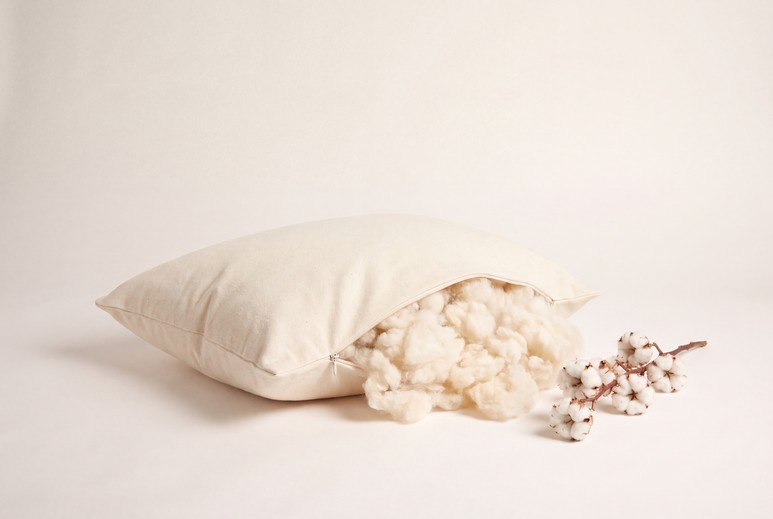
Cotton fill is mostly air held in a loose tangle of fibers. Once the air is drawn out and the bag sealed, the pressure of the room squeezes that tangle flat. The fibers bend and press against each other, but they are not cut. Each one keeps some spring, and once air can flow back in, that spring pushes the mass apart again.
Cotton has survived much harder squeezing than a pillow bag gives it. At the gin, lint is pressed to over 40 lb per cubic foot and then held at 28 by its ties (USDA ARS). The National Cotton Council lists cotton's natural resilience as one of the factors that set a bale's size. That baled lint is later opened back into loose fiber.
| Cotton at this stage | Packing, lb per cubic foot | Where the figure comes from |
|---|---|---|
| Lint at the moment a gin presses it | over 40 | USDA ARS |
| A tied universal density bale | 28 | National Cotton Council |
| A 2 lb standard pillow, 5 inches high, treated as a box | about 1.3 | Our arithmetic from one seller's listed weight and height, assuming a 20 by 26 inch case |
Even a tied bale is packed about twenty times tighter than your pillow at rest.
Folds slow the rise. Fibers pressed together grip one another by friction, so a folded batting layer can stay matted along the fold for a while. Damp fiber is also likely to rise more slowly than dry, so a pillow that sat in a damp warehouse may not match the seller's timing.
How long does a compressed cotton pillow take to recover?
Most of the rise happens in the first hours, but full height can take up to three days; one cotton-fill seller gives 72 hours as its figure.
No study has timed how a cotton pillow recovers after vacuum packing, so the best guide is what sellers say. The one cotton-fill seller we found that gives a figure says its pillow expands fully within 72 hours (Oregon Fiber Mill). A foam wedge maker explains why the wait is that long. The outer foam takes in air and gets back most of its shape within a couple of hours, but the core fills last, so the maker asks buyers to allow up to 48 hours before measuring (Sleepnitez).
Cotton batting is built in layers, so it probably also rises from the outside in, though no cotton seller we read says so. The room you leave it in changes the pace. Dry, moving air around the pillow helps, and a cold, damp room slows it. Leave the pillow uncased and judge it on the third day.
| When | What you are likely to see | What to do |
|---|---|---|
| Minutes after opening | A flat slab with sharp fold lines | Unroll it and smooth the folds by hand |
| The first few hours | Edges round out while the middle stays thin | Leave it uncased on a bed or chair |
| Day one to day three | Height creeps up and creases soften | Knead and turn it morning and night |
| After day three | Little further change | Compare it with the seller's listed height |
This table summarises what sellers say about the first three days.
Why do some compressed pillows recover faster than cotton ones?
Polyester fiberfill is made with a springy crimp and foam has a built-in shape to return to, while cotton batting relies on its own fiber spring.
The type of fill matters more than the bag. Molded foam has one fixed shape to return to, and polyester fiberfill is a man-made fiber with a springy crimp built into it. One compressed pillow sold under an organic cotton name has an organic cotton cover with fiberfill inside. Its listing tells you to run it in a dryer for 5 to 10 minutes on a fluff cycle (AllerEase listing at American Textile). That quick fix is written for fiberfill.
Cotton has no crimp like that. A textile patent built a finishing process on the idea that untreated cotton springs back less than polyester. It reported that its treated cotton matched or beat polyester in a plunger test of recovery (Google Patents). The patent set out to bring cotton up to polyester's level, which tells you that plain cotton started below it.
The two forms of cotton fill also behave differently. Batting comes as sheets, and a sheet folded for shipping can hold its crease for a while. Shredded cotton is loose, so clumps break apart when you knead them, though the pieces may settle unevenly at first. If your cotton pillow rises more slowly than a polyester one did, it is behaving normally.
What do cotton pillow sellers say about unpacking a compressed pillow?
We read nine seller pages for pillows with cotton in the name; most said nothing about arrival, and most that did were not filled with cotton.
We read 9 product pages on 29 October 2026. Each was for a pillow sold in the United States with cotton in its name or description, and we sorted them by what they tell you about arrival. Three describe vacuum packing and give a time or a method for recovery. One mentions vacuum sealing but gives neither. Five say nothing about packaging in the text we read. The count covers page text alone, and none of the pillows were handled here.
| What the page says about arrival | Pages | Which pages | Fill |
|---|---|---|---|
| Mentions vacuum packing, with a time or method | Three | Oregon Fiber Mill gives a time; AllerEase at American Textile gives a dryer cycle; a down alternative two-pack at Walmart says to pat it into shape | Cotton; fiberfill; down alternative fiber |
| Mentions vacuum packing, no time or method | One | Mastertex Maxi, which says only that the pillows unfurl in front of you | Microfiber |
| Nothing about packaging | Five | Cece's Wool, The Futon Shop, Healthy Body Head to Toe, Sachi Organics at Natural Linens, Organic Cotton Plus pillow forms | Cotton |
The fill column matters most. Only one of the four pages that mention compression is for a pillow filled with cotton. The other three put cotton covers over fiberfill, microfiber or down alternative fiber, so their unpacking advice is about a different material. If your pillow is filled with cotton, the 72-hour figure is the better guide.
How can you help a compressed cotton pillow fluff up?
Get it out of the bag and case at once, open the folds by hand, then knead and turn it a few times a day while air reaches every side.
Open the bag the day the pillow arrives. One maker of vacuum bags says that storage length matters more than the compression itself (Vacbird). That remark is about foam and latex, but the same logic applies to cotton: the longer fibers sit pressed, the longer they take to come back. Then work through these steps.
- Tear the plastic by hand, or cut well away from the fabric, because the pillow's fabric is pressed hard against the bag.
- Take off any pillowcase or protector so air reaches the pillow's fabric on every side.
- Unroll or unfold the pillow fully and smooth the fold lines with flat hands.
- Knead from the edges toward the middle, then hold the short ends and push them together a few times.
- Leave it on a bed or chair in a dry room and turn it over whenever you pass.
Skip the dryer unless the care label allows it. The dryer tips printed on many compressed pillows are written for fiberfill, not cotton. Follow the label on your own pillow, and read our page on washing a cotton pillow before putting cotton in any machine.
Does vacuum packing damage a cotton pillow?
Short shipping compression is unlikely to do lasting harm, but no one has published a test on cotton pillows, and long storage carries more risk.
We found no study that tests a cotton pillow before and after vacuum packing, so this answer is a judgement based on related evidence. Cotton survives the gin press, which is far harsher than any pillow bag, and is later opened into usable fiber. A few days or weeks in a shipping bag is mild by comparison.
Some loss is still possible. Fibers held flat for a long time can stay that way, and a fold pressed into batting may leave a soft crease for a while. One cotton pillow seller tells buyers to expect some compression over time, in a note separate from its delivery line (Oregon Fiber Mill). That slow settling is normal wear, and you will see it over months rather than days.
When a new pillow has a fault, the cause is usually something else. If a pillow arrives damp, smells of mildew, or has fill packed hard in one corner, it was probably packed wet or stored badly. That is a matter for the seller. Keep the box and bag for now, in case the seller asks for them with a return.
How do you know when a compressed pillow has fully recovered?
Measure its height on the third day and compare it with the height the seller lists; a pillow within reach of that figure has done its rising.
A ruler is the surest check. Lay the pillow flat with nothing on it and measure from the surface to the top at the center. Then look up what the seller lists. One cotton pillow listing gives its standard size as 5 inches high at the center and 4 inches at each end (Natural Linens). A figure like that is your target, and the pillow should come close to it by the third day.
If there is no listed height, use your hands. A recovered cotton pillow feels even across its surface, with no hard ridge where it was folded, and pushes back gently when you press it. Sharp fold lines on the third day mean the fill needs more kneading, not more waiting.
Compare the pillow with itself, too. If one end is clearly thinner than the other, the fill may have shifted while the pillow was rolled. On a zippered pillow you can move fill across by hand, and on a sewn one you can knead the thick end toward the thin end. If the height stays well short of the listing after that, contact the seller with your measurement.
Common questions
Six shorter questions people ask in the first days after a compressed pillow arrives, each answered in a few sentences you can act on now.
Can you sleep on a compressed cotton pillow the first night?
Yes. It will be thinner and firmer than it will be by the third day, so you may want a second pillow under it at first. Fluff it again in the morning and leave it uncased during the day.
Should you cut the plastic with scissors?
Tear it by hand if you can. The fabric is pressed tight against the bag, so a blade can nick the pillow's fabric, and one seller gives the same warning (Puredown).
Will sunlight help a cotton pillow expand?
Dry, moving air helps more than heat. A sunny, dry spot can freshen a pillow that feels slightly damp, but keep it off wet ground and bring it in before the evening dew.
Can you vacuum pack a cotton pillow yourself for a move?
You can for a short move. Open it as soon as you arrive, and don't leave it sealed for months, because the longer it stays sealed, the more likely the fill is to stay flat.
Do you need the vacuum bag to return a pillow?
Check the seller's return terms before you throw anything away. Most people have no way to vacuum seal a pillow again at home, so ask the seller how they want it sent back.
What should you do with the plastic bag?
Keep it away from small children while you wait to be sure the pillow is fine. After that, check whether your town takes plastic film for recycling, since the rules vary from place to place.
Sources
The cotton spec sheet's outside references, one line apiece, tagged with the section that cites them.
- Golocad (golocad.com), cited under “Key Takeaways”; “Why do cotton pillows ship compressed in plastic?”.
- Oregon Fiber Mill (oregonfibermill.com), cited under “Key Takeaways”; “How long does a compressed cotton pillow take to recover?”; “What do cotton pillow sellers say about unpacking a compressed pillow?”; “Does vacuum packing damage a cotton pillow?”.
- Natural Linens (naturallinens.com), cited under “Why do cotton pillows ship compressed in plastic?”; “What do cotton pillow sellers say about unpacking a compressed pillow?”; “How do you know when a compressed pillow has fully recovered?”.
- Puredown (puredown.com), cited under “Why do cotton pillows ship compressed in plastic?”; “Common questions”.
- USDA ARS (ars.usda.gov), cited under “What happens to the cotton inside a vacuum bag?”.
- National Cotton Council (cotton.org), cited under “What happens to the cotton inside a vacuum bag?”.
- Sleepnitez (sleepnitez.com), cited under “How long does a compressed cotton pillow take to recover?”.
- AllerEase listing at American Textile (shop.americantextile.com), cited under “Why do some compressed pillows recover faster than cotton ones?”; “What do cotton pillow sellers say about unpacking a compressed pillow?”.
- Google Patents (patents.google.com), cited under “Why do some compressed pillows recover faster than cotton ones?”.
- a down alternative two-pack at Walmart (walmart.com), cited under “What do cotton pillow sellers say about unpacking a compressed pillow?”.
- Mastertex Maxi (mastertex.us), cited under “What do cotton pillow sellers say about unpacking a compressed pillow?”.
- Cece's Wool (ceceswool.com), cited under “What do cotton pillow sellers say about unpacking a compressed pillow?”.
- The Futon Shop (thefutonshop.com), cited under “What do cotton pillow sellers say about unpacking a compressed pillow?”.
- Healthy Body Head to Toe (wholesale.healthybodyheadtotoe.com), cited under “What do cotton pillow sellers say about unpacking a compressed pillow?”.
- Organic Cotton Plus pillow forms (organiccottonplus.com), cited under “What do cotton pillow sellers say about unpacking a compressed pillow?”.
- Vacbird (vacbird.com), cited under “How can you help a compressed cotton pillow fluff up?”.