Can you wash a cotton pillow, and what happens if you do?
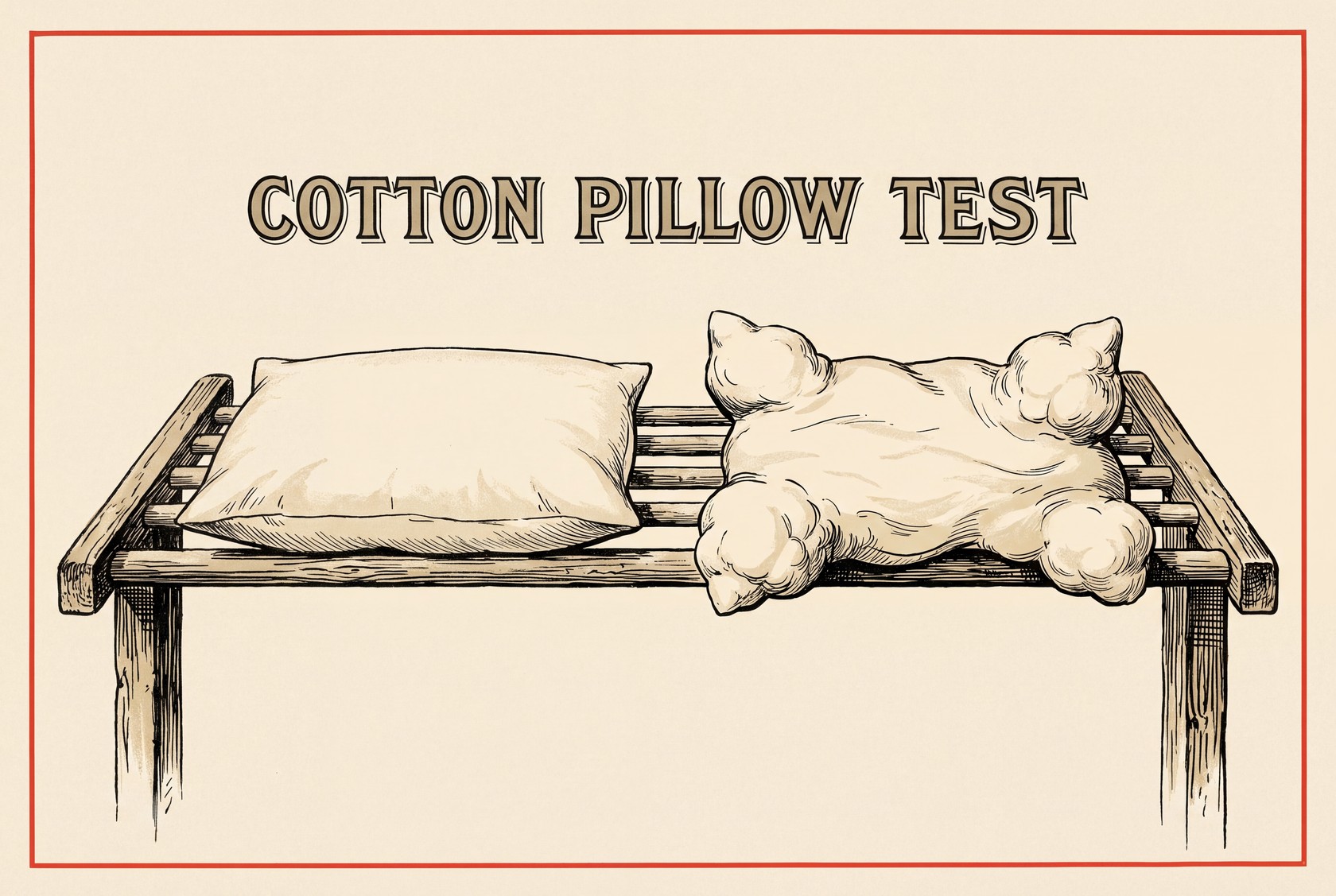
You can get a cotton pillow wet, but the fill inside rarely returns to the shape it had before. Whether a wash is worth the risk depends on what the seller built the pillow to survive, how hot your water runs, and how fast you can dry a dense core.
Short answer: Sometimes, but usually not the whole pillow. Of 6 cotton-filled pillow product pages we read, 4 say to keep the fill dry and spot clean it, 1 says to empty the fill and wash only the shell, and 1 gives machine-washing steps. Water does not weaken the cotton itself. The risk is batting that shifts into lumps and a core that stays damp past the 24 to 48 hours the EPA gives for drying wet items before mold can grow.
This guide is for: people who own a cotton-filled bed pillow and want it clean without ruining the fill.
Key Takeaways
These 3 points hold for most cotton pillows: the label usually says keep the fill dry, heat works on mites, and drying speed decides the outcome.
- 4 of the 6 cotton-pillow product pages we read tell you to keep the fill dry and spot clean it. Of the rest, one says to empty the fill and wash only the shell, and one gives full machine-wash steps.
- Water does not weaken cotton fiber, which gets stronger when wet. What fails is the batting, which shifts into lumps, and the core, which can stay damp past the 24 to 48 hours the EPA gives for drying wet items before mold grows.
- Allergy guidance calls for water of at least 130°F against dust mites. That is above the 120°F the Consumer Product Safety Commission urges for home water heaters, so a zippered cover you can wash hot does more than washing the pillow.
On This Page
Each of the 8 entries below matches a section heading on this page, in the order the sections appear, so you can jump straight to your question.
Can you put a cotton pillow in the washing machine?
Only if its own label says so. Most cotton pillow makers say keep the fill dry, because a soaked batting core shifts and dries slowly.
It depends on the pillow in front of you, and its label or product page is the only reliable guide. Most sellers of cotton-filled pillows tell you not to wash the whole thing. Sachi Organics says to spot clean only and not to machine wash the cotton fill (Sachi Organics). The Futon Shop says it does not recommend machine washing its organic cotton pillow, because washing can damage the fill and make it clump (The Futon Shop).
A few sellers see it differently. Organic Textiles calls its cotton-filled pillow machine washable and publishes step-by-step instructions (Organic Textiles). General sleep guides sit in between. The Sleep Foundation says pillows made with organic fibers like cotton can sometimes be machine washed and dried on low heat, as long as you take care to avoid shrinking and clumps (Sleep Foundation).
So the question has 2 parts, and only the first is easy. Will the pillow fit in the drum? Almost any pillow will. Will it come out as the pillow you paid for? That depends on how the fill was made and how quickly you can dry it. A pillow sold as spot clean only was designed around fill that never gets soaked, so washing it takes it outside the care it was built for. If you cannot find a label or a product page, treat your pillow as spot clean only. Our guide on whether an all-cotton pillow is worth buying covers what to check before your next one.
What do cotton pillow sellers say about washing the fill?
Most of the cotton pillow pages we read say keep the fill dry. A single page says wash only the empty shell, and another gives machine-wash steps.
We read 6 product pages for cotton-filled bed pillows on September 26, 2026, all on the sellers' own sites, and sorted each one by what it says about getting the fill wet. We counted only pillows whose fill is cotton. The count comes from reading those pages; we washed and tested no pillows. The pages fall into 3 buckets: 4 keep the fill dry, 1 washes only the empty shell, and 1 washes the whole pillow.
| Seller page | What it says about the fill | Bucket |
|---|---|---|
| Sachi Organics | Spot clean only; do not machine wash cotton fill | Keep the fill dry |
| earthSake | Sun and air, careful vacuuming, dryer on no heat only | Keep the fill dry |
| The Futon Shop | Machine washing not recommended; can cause clumping | Keep the fill dry |
| Lifekind | Spot clean only | Keep the fill dry |
| Rawganique | Zippered version: take the fill out and wash the ticking; keep the pillow dry | Wash only the empty shell |
| Organic Textiles | Machine washable, with written steps | Wash the whole pillow |
Even the page in the last bucket comes with conditions. Its care instructions call for a washer big enough for a pair of pillows so water flows freely, cold water, an extra cycle, and a low dryer, then a check that the pillows are fully dry (Organic Textiles care page). An older blog post from the same seller calls for hot water instead (Organic Textiles blog). Follow the instructions for the exact pillow you own rather than a general article, since the seller knows how its batting was made.
What happens to cotton fill when it gets soaked?
Cotton fiber gets stronger when wet, so the fiber survives. The batting is what fails: layers slide, fibers mat together, and lumps form.
Start with what does not happen. Cotton does not break down in a single wash. A cotton processor's technical note explains that cotton does not lose strength when wet the way rayon does, and in fact gets stronger (Barnhardt).
The structure is what gives way. Pillow fill comes as layered batting or loose shredded pieces, and both get their height from air held between the fibers. As the fibers take up water and the drum tumbles and spins, layers slide against each other and press into dense mats that do not spring back on their own. That is the clumping The Futon Shop warns about. The two fill types fail in different ways, and our guide on batting versus shredded cotton fill explains how.
The table below is our judgement, built from the seller statements and fiber facts on this page. No maker publishes it.
| Part of the pillow | What a full wash does | Can you undo it? |
|---|---|---|
| Emptied cotton cover or ticking | Cleans well; can shrink in hot water or a hot dryer | Yes, if washed cold and hung |
| Layered batting | Layers shift and mat into flat lumps | Partly, by hand, if there is a zipper |
| Shredded cotton fill | Pieces roll into balls | Mostly, if you can pull them apart |
| Sewn-shut pillow of either fill | Lumps are trapped where you cannot reach them | Rarely |
For the cover, Holy Lamb Organics tells owners of its all-cotton zipper cases to use cold water only and hang them to dry, so they do not shrink (Holy Lamb Organics).
Why does drying time decide whether a washed cotton pillow survives?
A thick cotton core stays wet long after the cover feels done, and it can grow mold; until it dries, it also sleeps cold and clammy.
A bed pillow packs a lot of cotton into a small space, and all of it has to dry from the center outward. That is why the middle is the last part to feel right under your head.
The surface will fool you. The Sleep Foundation notes that the fill inside may need extra time in the dryer even when the cover feels dry, and that dryer balls or dry towels can speed things up (Sleep Foundation). A pillow that feels done on the outside can stay wet in the middle for hours, and until it dries it feels cold against your face, because water leaving the fill carries heat away with it.
The clock matters because of mold. The EPA says that in most cases mold will not grow if wet or damp items are dried within 24 to 48 hours (EPA). A cotton core that is still damp days later is outside that window, and a musty smell after washing is the usual sign. That is why Rawganique tells owners to keep its cotton pillow completely dry at all times (Rawganique).
You can check the center yourself. Squeeze the middle of the pillow hard, then press that spot against the inside of your wrist. If it feels cool, there is still water in it. Keep drying until the middle feels as warm and dry as the edges, even if that takes several more cycles.
Does washing a cotton pillow get rid of dust mites?
Allergy guidance points to hot water, hotter than many home water heaters deliver, and a zippered cover you can wash hot is the easier route.
Heat is what works on mites, and a cool wash mostly just gets them wet. Allergy guidance calls for water of at least 130°F. Nationwide Children's Hospital tells families to wash sheets, blankets and other linens in hot water every week, and says the water should reach that temperature to deal with dust mites (Nationwide Children's Hospital).
Here is the catch. The U.S. Consumer Product Safety Commission urges households to lower their water heaters to 120°F, both to prevent scald burns and to save energy (CPSC). Your hot tap may not reach the heat the allergy guidance asks for, and your pillow's label may not allow it anyway. Washing a dense cotton core in very hot water also brings back every drying problem described above.
The same guidance points to another route. Nationwide Children's advises buying allergy covers for all the pillows on your bed. A Mayo Clinic advice column says tightly woven covers keep dust mites from colonizing or escaping from pillows and mattresses (Mayo Clinic News Network). That is the practical route for a cotton pillow. A zippered cover that can take hot water handles the mites, and the fill stays out of the washer.
How do you machine wash a cotton pillow whose label allows it?
Use a large washer, cold or warm water, a small dose of mild detergent, an extra rinse and spin, then low heat until the center is dry.
Only do this if the label or product page says the whole pillow can go in the machine.
- Check every seam and the zipper first. Sew up any gap, because loose fill escapes quickly during a spin.
- Wash 2 pillows together so the drum stays balanced, in a machine big enough for water to move freely around them (Sleep Foundation; Organic Textiles care page).
- Use the water temperature your label gives, a gentle cycle, and a small amount of mild detergent. The Sleep Foundation says that combination suits most pillows.
- Run 1 extra cycle, as the Organic Textiles instructions describe, so less soap stays behind in the core.
- Dry on low heat with dryer balls, or with tennis balls tucked into clean socks, as the same instructions suggest.
- Every so often, take the pillow out and break up any lumps by hand. Stop only when the center passes the wrist test above.
Expect some change. A washed batting pillow usually comes out flatter and firmer than it went in, because packed fibers rarely spring all the way back. Cotton also flattens with ordinary use. Lifekind says its cotton fill compresses by about half over time (Lifekind), and earthSake also expects its fill to compact as you sleep on it (earthSake). Our guide on why cotton pillows flatten covers how much of that you can reverse.
How do you clean a cotton pillow that says spot clean only?
Treat the stain, not the pillow. Dab with a mild soap or vinegar solution, keep the wet patch small, and dry it in sun or moving air.
Spot cleaning is what most cotton pillow sellers expect you to do. It works because the wet patch stays small enough to dry in hours rather than days. Strip the pillow first. Wash the pillowcase and any protector on their own, then match your problem to the 6 fixes below.
| Problem | What to do | Basis |
|---|---|---|
| Fresh stain | Spray or dab a weak mix of white vinegar and water, or a little mild detergent, then dry in sun | Mix given by earthSake and Rawganique |
| Stain on a pillow with no zipper | Warm water, gentle soap and a brush, used sparingly | Rawganique |
| Smell with no stain | Air it in the sun, or sprinkle baking soda and shake it out | earthSake and Rawganique |
| Sweat soaked into the core | Surface cleaning will not reach it; add a protector, and replace the fill if it smells | Our judgement |
| Dust mite allergy | Encase the pillow and wash the cover hot | Allergy guidance above |
| Spilled drink | Blot at once, pull out wet fill if there is a zipper, and dry everything fully inside the EPA window | EPA drying window |
Spot cleaning will not reach sweat and oil that have soaked deep into the core, and that is the case for a protector, which keeps them out of the fill in the first place. Sachi Organics recommends a protector to keep its cotton pillow clean and make it last longer (Sachi Organics).
Can a lumpy cotton pillow be fixed after washing?
Often, if the pillow has a zipper. Pull the matted fill apart by hand, dry it fully, and restuff it; a sewn-shut pillow is much harder.
If your pillow has a zipper, you can usually fix lumps by hand. Rawganique tells owners of its zippered version to take the fill out before washing the ticking, and that same opening gives you a way in to rework matted fill (Rawganique). Work through these 5 steps:
- Open the pillow in a dry room and take all the fill out.
- Pull clumps apart into loose tufts, or peel matted batting layers away from each other and lay them flat.
- Spread everything out and let it dry completely before it goes back in.
- Restuff the corners first, then the middle, and zip it closed.
- Replace any fill that stays hard and matted once it is dry.
A sewn-shut pillow is harder. You can tumble it on no heat with dryer balls, which is the only dryer setting earthSake allows for its pillows, and knead the lumps by hand between rounds. If lumps are still there once the pillow is fully dry, they tend to stay. A musty smell after drying is a reason to replace the fill or the pillow, not to wash it again, because it means the core stayed wet too long.
Common questions
These 6 short answers cover follow-up questions about washing cotton pillows, from pillowcases and protectors to sunlight and replacing the fill.
Can you wash a cotton pillowcase in hot water?
Yes, if the case allows it. Nationwide Children's Hospital advises washing linens in hot water weekly for people with dust mite allergy (Nationwide Children's Hospital). Holy Lamb Organics tells owners of its cotton zipper cases to wash them cold so they do not shrink (Holy Lamb Organics).
Can a hot dryer get rid of dust mites in a cotton pillow?
A Mayo Clinic advice column suggests a hot dryer cycle for bedding that cannot be washed hot (Mayo Clinic News Network). Check your label first: earthSake allows no heat at all, while Sachi Organics suggests a short fluff on low.
Does sunlight clean a cotton pillow?
It airs and dries the fill, and several sellers recommend it. It does not lift stains, and an allergy clinic notes that sun exposure does not remove mite waste (Allergy, Asthma & Sinus Center).
Can you hand wash a cotton pillow in the tub?
Hand washing skips the spin cycle, which the Sleep Foundation says is the part that can damage a hand-wash pillow (Sleep Foundation). The core still soaks through, though, so getting it dry in time is just as hard.
Can you dry clean a cotton pillow?
earthSake says not to (earthSake). If your own label does not mention it, treat dry cleaning like washing: outside the care the pillow was built for.
How often should you clean a cotton pillow?
Wash the pillowcase once every 7 days, as Nationwide Children's Hospital advises for linens. Air the pillow itself every few months, and spot clean spills the day they happen.