Does staple length decide how long a cotton pillow stays useful?
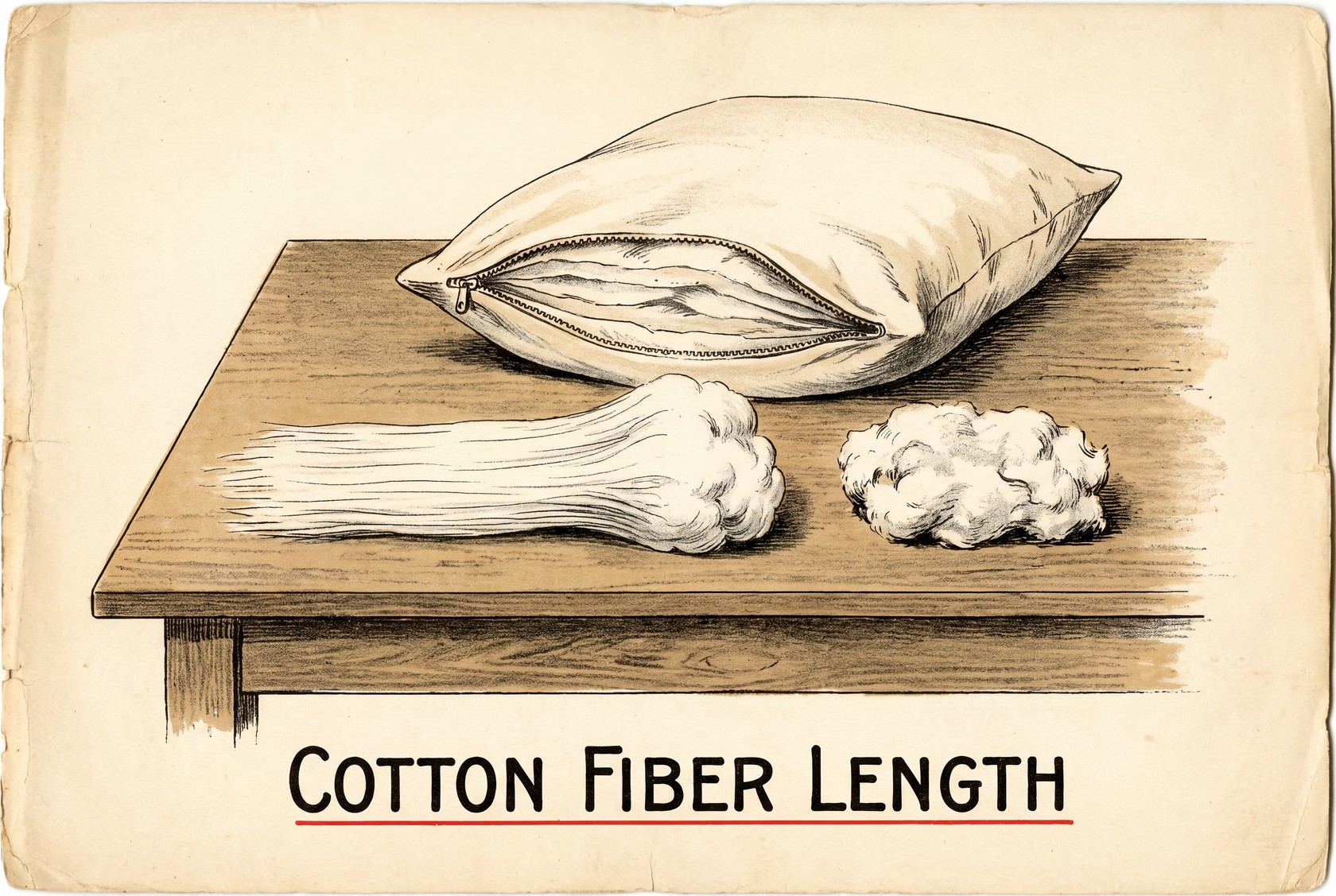
Staple length is the length of a cotton fiber. It is graded on every bale grown in the United States. It affects how well cotton holds together, first as yarn in the pillow cover and then as carded batting inside. It almost never shows up on a pillow listing, so you have to judge it from other signs.
Short answer: Partly. Longer fibers make a stronger, smoother cover fabric. In the fill they probably keep the batting in one piece for longer. Fibers under 1/2 inch pack down, clump and shed. USDA tests a sample from every bale and grades its length in thirty-seconds of an inch (USDA AMS). Even so, none of the 10 pillow and batting pages we read gave a staple length. Cotton batting can condense over time to about half of its original volume (Cece's Wool), so spare fill matters too.
This guide is for: people buying or refilling a cotton-filled pillow who want to know whether a fiber-length claim on a listing is worth paying for.
Key Takeaways
Three findings, each with a figure you can check: how fiber length is graded, where short fiber ends up, and how much cotton fill settles.
- US grading counts any fiber under half an inch as short fiber. In one USDA-AMS comparison across growing regions, short fiber content ranged from 7.9 to 5.8 percent and was lower in the longer staple cottons (Beltwide Cotton Conferences). So longer-staple cotton carries less of the fiber that packs down and sheds in your pillow.
- None of the 10 cotton pillow and batting pages we read stated a staple length. Two described a fiber grade or mix. Five named where the cotton was grown. Three gave only the fiber type and its certification. You usually cannot read fiber length off a listing, so you have to ask for it.
- Cotton batting can condense to about half its original volume, according to Cece's Wool, which also suggests 2 to 3 pounds of batting for a standard pillow (Cece's Wool, pillow; Cece's Wool, batting). A zipper and spare fill affect how long your cotton pillow stays useful about as much as the fiber does.
On This Page
Eight questions in the order a buyer tends to ask them, from what staple length means to what happens as the fill wears over time.
The first 3 sections explain what staple length is and how it is graded. The next 2 cover what it changes inside a pillow, and where the evidence is solid and where it is only inferred. The last 3 turn that into things you can check: our count of what sellers publish, a table for reading listings, and what to expect as the fill settles.
What is staple length in cotton?
Staple length is the length of a cotton fiber, and in US grading it means the average of the longer half of the fibers in a sample.
A cotton fiber is a single cell that grows from the seed, and the fibers in one boll never come out the same length. That is why graders report a summary figure instead. In US classing, fiber length is the average length of the longer half of the fibers (upperhalf mean length) (Textile Exchange). The shorter half gets its own measure, called uniformity.
For a pillow, the spread of lengths matters more than the headline number. Cotton fibers vary naturally in length, so length uniformity is never perfect, and cotton with a low uniformity index is likely to have a high percentage of short fibers (Cotton Incorporated). Two bales with matching staple length can carry very different amounts of that short fraction.
Sellers also use the word loosely. Sheet and pillowcase sellers print "long staple" to suggest softness, usually with no figure behind it. If you see the phrase on a pillow, ask which part it describes: the fabric you touch or the fill you sleep on. Mills pick cotton for those two parts for different reasons.
One useful way to think about staple length is as a measure of how many neighboring fibers each fiber can reach. That idea explains most of what follows.
How does the USDA measure and grade staple length?
Every US bale is sampled and run through an instrument that reads length in hundredths of an inch, then given a staple code.
USDA's Agricultural Marketing Service tests a sample from every bale produced using cotton classification electronic instrumentation. The instruments read length in hundredths of an inch, and that reading is translated into a staple code counted in thirty-seconds of an inch (USDA AMS). A staple code of 32 means roughly 1 inch (USDA AMS, Understanding the Data). If you ever see a two-digit staple code on a cotton spec sheet, that is what it means.
Length is only one line on the grading record. Short fiber content means the share of fibers shorter than half an inch (Cotton Incorporated), and mills watch it closely. In an ITMF survey of textile companies in more than a dozen countries, nearly all of them said short fiber content is important or very important for processing cotton (Beltwide Cotton Conferences).
USDA grades organic cotton too. Bales from the Texas Organic Cotton Marketing Cooperative are a good example: TOCMC organic cotton is classed by USDA just like non-organic cotton (Silver Needle & Thread).
So if your pillow is filled with US-grown cotton, someone up the supply chain recorded a staple figure for it. Whether you ever see that figure depends on the seller. The count later on this page shows how rarely it gets passed on.
How long are upland, long-staple and Pima cotton fibers?
Most US cotton is upland at about an inch; Pima runs longer; linters and comber waste are far shorter, and those can end up in fill.
Knowing the usual lengths tells you what a plain "cotton" label most likely means for your pillow. Upland cotton makes up 97% of what's grown in the U.S. (CottonWorks). Pima is a different species with longer fibers and is sold as extra-long staple. So unless a listing names the fiber, you are most likely sleeping on upland cotton about 1 inch long, or on something shorter. Standards bodies draw the lines differently.
| Category | Length | Who defines it |
|---|---|---|
| Short fiber | Under half an inch | Cotton Incorporated |
| Typical upland, staple code 32 | About one inch | USDA AMS |
| Long staple | Longer than typical upland, short of extra-long | ICAC, via Wikipedia |
| Extra-long staple | 1 3/8 inch or longer | ICAC, via Wikipedia |
| American Pima | Extra-long staple; a small share of the US crop | USDA, via Cynida |
The fibers that matter most for fill are shorter than anything a spinner wants. Combing takes out the short fibers, called noil, and fabric made from noil is weaker and often considered less valuable (Wikipedia, Noil). Comber noil can be used as stuffing material for pillows, cushions, toys, and upholstery (Paras Textile). Linters, the short fuzz left on cottonseed after ginning, turn up in batting too. One upholstery batting is made mostly of linters and motes, both by-products of ginning, with a smaller share of straight fiber (Rochford Supply). If you see these words on a pillow listing, expect a fill that packs down sooner.
Why does short fiber make a cotton pillow flatten and clump sooner?
Batting holds its shape through friction between fibers. Short fibers have fewer contact points, so they slip, pack into lumps and shed dust.
I could not find a published study that compares pillow life with staple length directly. What follows is our reading of spinning and nonwoven research applied to a pillow. Treat it as reasoning; nothing here was tested.
In yarn, longer fibers grip each other over more surface, so a yarn of a given fineness can be spun with less twist and still hold together (Cynida). A carded layer of batting has no twist at all. Only friction and tangling between fibers keep it together as one layer. A long fiber crosses many neighbors. A fiber 1/4 inch long crosses only a few, and pressure night after night lets it slide into denser pockets. Short fibers have fewer neighbors to hold on to, so they are the first to slip. That slipping is what you feel as hard lumps after washing. One seller of organic cotton fiberfill says as a purely organic material, it does clump up a bit when machine washed (HoneyBeGood).
Cotton also does not spring all the way back. Research on highloft nonwovens reports that after removal of a compressive load, the nonwovens thickness will not completely return to its initial state, and a permanent compressive deformation occurs. Zhang and Chen also report that a higher cotton share in a blend lowers elasticity (Zhang and Chen). Short fiber adds a second kind of loss, which is dust. One organic batting seller recommends a dust mask when you handle its batting, because dust and loose fibers from this product may cause irritation (Organic Cotton Plus).
Does staple length matter more in the cover or in the fill?
In the cover, staple length is well studied and affects pilling and strength. In the fill, the effect is inferred but you will rarely see a number.
The strongest evidence is about the cover. High short fiber content weakens yarn and makes it less even, because shorter fibers have less cohesive power (Textile Trade Buddy). A long-staple cover will usually stay smoother, since longer fibers leave fewer loose ends in a length of yarn, which is why extra-long staple yarn tends to pill less (Cynida).
The fill is different. Nobody spins it. A batting mill can card whatever fiber it buys, including the short fibers that spinners pay to have removed. That makes the fill the part of the pillow where staple length is hardest for you to see. It is probably also where length most affects how long the pillow keeps its height.
| Part of the pillow | What staple length changes | How strong the evidence is | What sellers usually publish |
|---|---|---|---|
| Cover fabric | Yarn strength, pilling, surface smoothness | Strong: well studied in spinning | "Long staple" or a thread count, rarely a figure |
| Carded cotton batting | Whether the batting stays in one layer, clumping, dust | Inferred from yarn and nonwoven research; no direct pillow study found | Certification or origin; sometimes a grade mix |
| Loose raw cotton | Same as batting, plus leftover seed and leaf | Seller descriptions only | Where it was grown and ginned |
If you want a pillow that keeps its height for years, ask about the fill separately. A long-staple cover over unknown fill only describes the case.
What do cotton pillow listings say about fiber length?
We read 10 US pages selling cotton-filled pillows or cotton batting for fill. Not one gave a staple length in inches or as a staple code.
We read 10 US product pages on 2026-09-26. Each one sells either a cotton-filled bed pillow or cotton batting offered as filling. We noted what each page says about the fiber and sorted it into one of three buckets. We did not weigh, wash or handle anything for this count. It records only what the pages say.
| Bucket | Pages | What they say |
|---|---|---|
| Describes a fiber grade or mix, no length | 2 | Rochford Supply lists linters, motes and straight fiber by share; FoamOnline sells batting by a staple grade ratio |
| Names the grower or region, no grade | 5 | Cece's Wool pillow and Cece's Wool batting (Texas and US cotton); Sachi Organics and Pike's Brand (Texas Organic Cotton Marketing Cooperative); Thunder Acres (grown and ginned in Kansas) |
| States fiber content or certification only | 3 | Rawganique; Organic Cotton Plus; HoneyBeGood |
None of the pages gave a staple length in inches or thirty-seconds. Sellers named the grower more often than the grade. 5 of the 10 pages told you where the cotton came from. Only 2 described the kind of fiber in the product, and both of those were upholstery battings, not bed pillows.
This gap could be closed. In the count, 2 pillow makers name the Texas cooperative as their source, and that cooperative's bales carry USDA grading records. You can fairly ask a seller whether they know the staple length of the cotton they buy. The only line in the whole set that spoke to how long a pillow lasts came from a pillow maker. It was about settling, which is covered below.
How can you judge the fill when no staple length is listed?
Ask for the grade, open the zipper, and pull a tuft apart. Long fibers draw out into a thin web; short ones break off and leave dust.
Start with the listing, then ask the seller, then check the pillow yourself. The table sorts the claims you are likely to see.
| What the listing says | What it tells you | Our judgement |
|---|---|---|
| A staple figure or staple code | The seller has grading data | The strongest sign you will find; confirm it describes the fill |
| "Long staple" with no figure | A claim with no scale, often about the cover | Treat it as a cover claim unless the fill is named |
| Linters, motes or noil in the mix | Short by-product fiber is present | Expect faster packing; fine in upholstery, weak in a bed pillow |
| A grade ratio in the product name | That seller's own grade | Compare within one seller, not across sellers |
| Grower or region only | The cotton can be traced | Ask for the bale's USDA grading data |
| Certification only | Rules on farming and processing | Says nothing about fiber length |
If the seller knows nothing about the fill fiber, check it at home. Open the zipper and pull a small tuft from the middle of the batting. Long fiber draws out into a thin, even web before it separates. Short fiber snaps into little pieces and leaves dust on your fingers. It is a rough test, and it still tells good batting apart from linter-heavy padding. Look for seeds and leaf bits too. Our page on what cotton fill is compares batting with loose fill, and the organic cotton pillow checklist covers certificates.
What should you expect as a cotton pillow ages?
Expect settling. One seller says cotton batting can shrink to about half its volume, so plan on topping up fill rather than on a fixed lifespan.
A zipper and spare fill will do more for your pillow's working life than any fiber claim. One maker says each pillow is filled with at least 2 pounds of cotton batting and has a zipper closure to allow access to the stuffing. It also warns that batting can condense to about half its original volume (Cece's Wool). Settling is normal for cotton. A 1-pound bag of batting costs $16.95 on Cece's Wool's batting page (Cece's Wool). With a zipper, you can add a handful of fill when the pillow sinks instead of buying a new one.
What varies is how evenly it settles. Thick layers of cotton pack down faster than thin ones. An upholstery supplier describes futons filled with solid cotton several inches thick, where the cotton packs down in a relatively short period of time to create the hammock effect (FoamOnline). A thick cotton pillow can sink in a similar way, only on a smaller scale.
We found no seller or study that gives a lifespan in years, so we are not going to make one up. Watch the pillow instead. In our judgement, your cotton pillow is still useful as long as fluffing and topping up bring its height back. It is worn out when the batting has turned into hard lumps you cannot pull apart, when dust collects at the seams, or when new fill no longer spreads evenly. Based on the evidence above, short-staple fill likely reaches those points sooner. Our look at whether a 100% cotton pillow is worth buying weighs this upkeep against the price.
Common questions
Short answers to common questions about fiber length, fill grades, washing and refilling a standard cotton pillow yourself at home.
Is Pima cotton fill worth paying more for?
Only if the seller can show that the fill is Pima, not just the cover. Pima cotton is well suited for premium goods, and longer fibers create thinner yarn (CottonWorks). When a pillow is sold as Pima, the claim usually refers to the case.
Does organic cotton have a longer staple than conventional cotton?
Not by definition. Organic certification covers how the cotton is grown and processed, and US organic bales are graded by USDA like any other bale. An organic pillow can hold long or short fiber, so you still need to ask.
What does "long staple" mean on a pillow listing?
Usually it means the cover fabric is spun from longer fiber. Standards bodies draw the line in different places, and most listings give no figure. You should read it as a claim about the case unless the listing names the fill.
Can you wash a cotton-filled pillow?
Some sellers allow it. One fiberfill seller says its organic cotton stuffing clumps a little in the machine and suggests spot cleaning instead (HoneyBeGood). A removable outer case you can wash avoids the problem.
How much fill does a standard 20 by 26 inch pillow take?
For a pillow that fills out evenly and supports your head, one batting seller suggests 2 to 3 pounds (Cece's Wool). Buying 1 extra pound when the pillow is new lets you top it up later with matching fiber, so your pillow feels the same after it settles.
Why does a cotton pillow get hard lumps?
Pressure and washing push fibers together into dense pockets. Short fiber has fewer contact points to resist this, so fill with a lot of linters lumps sooner. You can pull the lumps apart by hand for a while. Once they will not separate, add new fill or replace it.