Is a 100% cotton pillow worth buying?
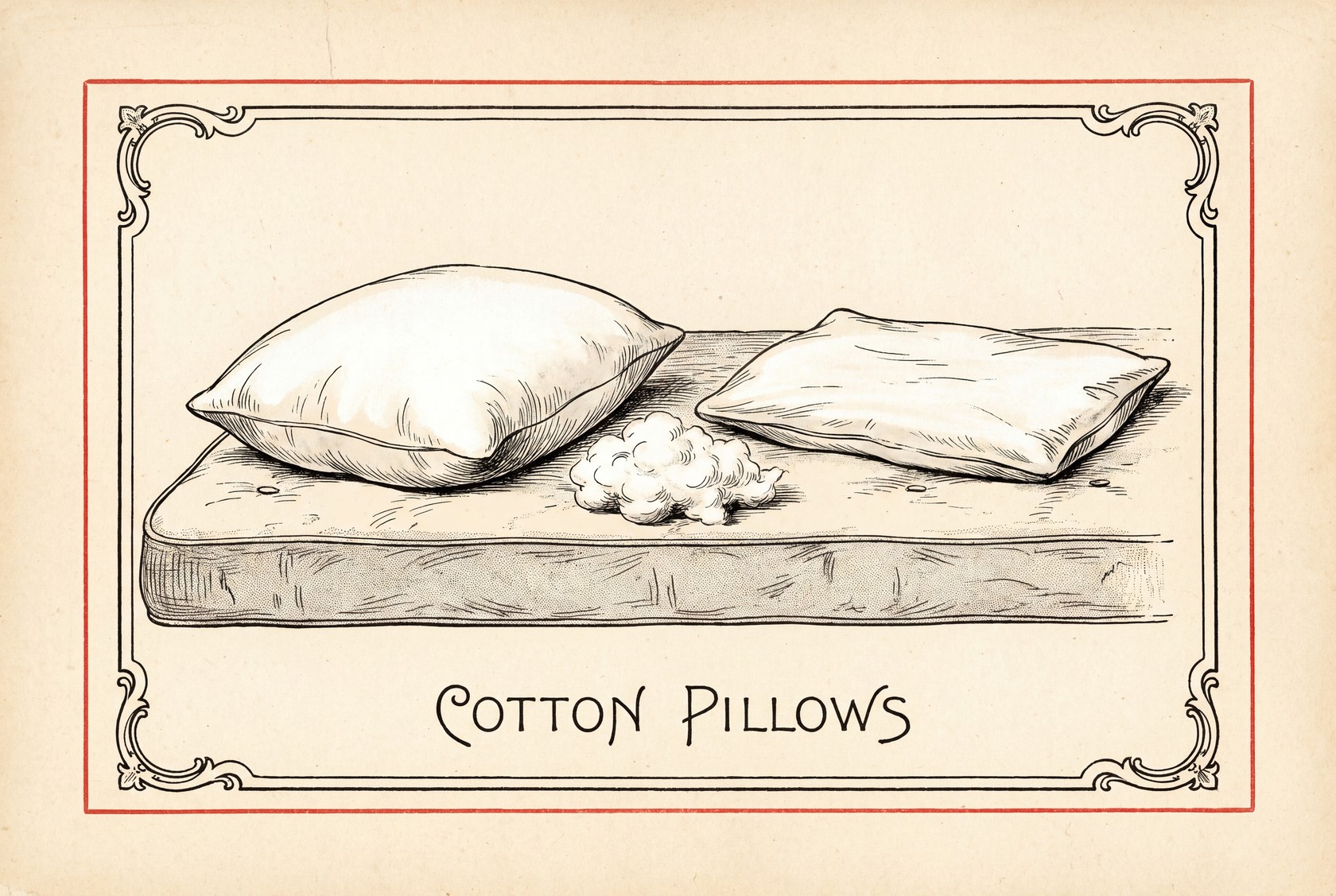
On a US store page, "cotton pillow" can mean two different things. It can be a pillow stuffed with cotton batting, or a down or polyester pillow in a cotton shell. Which one arrives decides how the pillow feels, how it changes with use and how it is kept clean.
Short answer: A true cotton pillow has cotton inside and out, and it sleeps firm and fairly low. The sellers who mention it say the batting settles to about half its new bulk. Buy more height than you want on night one, or choose a zippered pillow so you can add fill later. Under FTC rules "100% cotton" should mean only cotton, but check the fill line anyway. Cotton batting rarely goes in a washer, so a washable cover does the hygiene work.
This guide is for: people in the United States choosing a cotton-filled bed or body pillow who want to read a listing correctly before they pay.
Key Takeaways
This guide rests on 3 figures: how far cotton fill settles, what a 100% label covers, and how hot to wash the bedding around the pillow.
- Only 2 of the 12 seller pages we read warn that cotton fill settles, and both put the loss at about half its new bulk (our count). Plan for a pillow that sleeps lower than it arrives.
- "100% cotton" should mean only cotton (FTC). Even so, a shop can list a pillow with a cotton shell and down inside under that term, so read the fill line.
- The Mayo Clinic advises washing bedding in water of at least 130°F (54.4°C) to control dust mites (Mayo Clinic). Cotton batting usually can't be washed, so a zippered cover that takes a hot wash matters more.
On This Page
These are the 9 questions in the order a shopper tends to ask them, from what the label means to how the pillow behaves after months of use.
What does "100% cotton pillow" mean on a label?
It should mean the whole pillow is cotton, yet many shop listings use the phrase for the cover alone, with down or polyester inside.
Under federal rules the phrase carries a real promise. The FTC says a product should not be labeled "100% Cotton" unless it contains only cotton, apart from some non-cotton trim (FTC). The regulation behind that guidance lets a seller use "All" or "100%" where a product or a part of it is made wholly of one fiber (federal textile rules, eCFR).
That second clause is where shoppers get caught. A listing can truthfully call its shell all cotton while the inside is something else. One large US retailer's category page for cotton bed pillows includes a pillow with a pima cotton outer fabric around duck down and feather (Wayfair). Nothing on that page is false, because the cotton is on the outside.
For cotton inside, look for "cotton fill" or "cotton batting" on the fill line, not just in the title. There is a longer explainer on the batting itself at what cotton fill is.
| What the listing says | What it usually covers | What to check next |
|---|---|---|
| "Cotton" in the title, fill not named | Often the shell fabric only | The fill line, where down or polyester is common |
| "Cotton fill" or "cotton batting" | The inside is cotton | Whether the shell is cotton too |
| "Organic" with a GOTS mark | The finished product meets the higher GOTS grade | The seller's certificate or licence number |
| "Made with organic" with a GOTS mark | The finished product meets the lower GOTS grade | What the rest of the fiber is |
Is an organic cotton pillow different from a regular one?
The fiber feels the same either way. Organic is a claim about how cotton was grown and processed, and a certificate makes it checkable.
Organic and conventional cotton feel alike in a pillow. The word describes farming and processing, and the part that helps a buyer is a certificate that someone else audits.
The Global Organic Textile Standard has two grades. A product labeled "organic" needs at least 95% organic fibre, and "made with organic" needs at least 70% (Global Standards, GOTS key features). The same page says a product can only be sold under the GOTS label if every company that processed it is certified by an approved independent body.
The US Department of Agriculture accepts that route. Textiles that meet GOTS may be sold as organic in the United States. However, a label may not claim the finished product is USDA organic, or carry the USDA seal, unless the finished product itself is certified to USDA rules (USDA Agricultural Marketing Service). The two marks are not interchangeable. If the certificate on a listing names only the pillowcase, it says nothing about the fill.
Being organic does not change how firm the pillow is, how it settles or how you care for it. Treat it as a question about farming and supply chains. Judge comfort by fill weight and height instead, which the next two sections cover.
How much cotton fill goes into a cotton pillow?
One seller that states a weight puts a standard bed pillow at 3 to 4 pounds of cotton, and more fill makes a firmer, taller pillow.
Fill weight is the most useful number on a cotton pillow page. Words like soft, medium and firm are each seller's own scale, but pounds of batting can be compared across shops. More batting gives you a firmer, taller pillow, and a lighter fill gives you a softer, lower one.
One seller shows the trade clearly. It sells its standard pillow in a medium and a firm fill, and the firm version carries more batting and costs more (Rawganique). What the extra money buys is a pillow that starts higher and has more to lose before it sleeps flat. At the other end, a thin Japanese-style pillow uses far less cotton and is made for people who want their head low (Futon Tokyo).
If a page gives no weight, ask for it before you buy. Without it, there is no way to compare one seller's medium with another's, or to guess how tall the pillow will be once it settles. For readers still deciding between cotton and other fills, our comparison page sets them side by side.
| Fill on the seller page | Stated cotton fill | What you get on night one | What you get after it settles |
|---|---|---|---|
| Rawganique standard, medium | 3.3 lb | Medium height and firmness | A low pillow, likely too flat for side sleepers without extra fill |
| Rawganique standard, firm | 4 lb | A tall, firm start | A middle height for many people |
| Futon Tokyo extra-thin | Far less than either pillow above | A low pillow | Very low, and the seller suggests adding a pillow on top |
Does a cotton pillow go flat over time?
Yes, to a point. Cotton batting packs down under the weight of a head, and sellers who describe it say it ends near half its first bulk.
Cotton batting is fiber with air trapped in it, and a sleeping head presses that air out night after night. One seller warns that the weight of your head will compress the cotton until the pillow is about half as thick as when it was made. It suggests adding another pillow on top if that ends up too low (Futon Tokyo). The one other seller page in our count that raises the subject puts the loss at about half as well.
Half is a large change. A pillow that feels tall when it arrives can sleep much lower after steady use, which is worth planning for before paying.
There are two practical answers. The first is to buy more height than you want on the first night, expecting it to settle. The second is to buy a zippered pillow and add batting later. One seller sells extra organic cotton batting. It recommends buying the firmest pillow in a zippered version so the fill can be adjusted over time (Rawganique).
A zipper helps in the other direction too. If a new pillow is too tall for your neck, you can pull some batting out rather than wait for it to pack down. You can keep the spare fill in a cotton bag and put it back once the pillow has settled.
What do cotton pillow sellers say about flattening?
Most seller pages we read say nothing about cotton fill settling. Two warn you plainly, and one suggests cotton holds up better than synthetics.
We read 12 seller product pages for cotton-filled bed and body pillows on September 23, 2026. We counted what each one says about the fill settling and sorted every page into one of three buckets. Our method page explains how.
| What the page says about settling | Pages | Which pages |
|---|---|---|
| Warns that cotton fill compresses, to about half | 2 | Cece's Wool; Futon Tokyo |
| Does not say the fill compresses | 9 | Pike's Brand; Luxury Mattress Gallery; Rawganique bed pillow; Rawganique body pillow; The Futon Shop; Pure Living Space; Vincent Manufacturing; Organic Textiles; Looms & Linens |
| Suggests cotton holds its shape better than synthetic fill | 1 | Sachi Organics |
Only 2 of the 12 pages warn buyers that cotton fill compresses, and both put the loss at about half. The other 9 pages say nothing on the subject.
One page goes the other way. It says that synthetic fills can flatten over time, while quality cotton fill gives consistent comfort and support (Sachi Organics).
That silence is the finding. Settling is the property most likely to change how a cotton pillow sleeps, yet most pages leave buyers to find out after purchase. The table records what the page text says, not how any pillow performs. If a seller covers settling somewhere outside the product page, such as an FAQ, it would move to a different bucket.
What height should a cotton pillow be?
A review points to a head height of about 3 to 4 inches for many adults, so a cotton pillow should start taller than that before it settles.
Sellers often call pillow height "loft." This guide says height throughout. There is no single right number, because the gap between your head and the mattress depends on your build and how you lie.
A clinical paper summarizing an earlier systematic review reports moderate evidence for a pillow height of 7 to 11 cm (PMC).
That range tops out just over 4 inches, and it is a sensible starting point if you sleep on your back. People who sleep on their side generally need more, because the shoulder holds the head up off the mattress. People who sleep on their stomach usually want less, since a tall pillow bends the neck backward.
Now apply the settling figure from the sellers above. If the batting ends near half its first thickness, a pillow meant to sleep at 4 inches has to start near 8. That is simple arithmetic on the sellers' own numbers. It also explains why a cotton pillow can feel too tall on the first night and right a few months later.
A zipper takes the guesswork out of this. Start with the pillow full and sleep on it for a few weeks. Then remove batting until your neck feels level rather than bent up or down.
Is a cotton pillow good for dust mite allergies?
No study we found tests cotton fill directly. Pillow research compares synthetic and feather fills, and the cover weave may matter more.
We found no study that measures dust mites in cotton-filled pillows. The research compares synthetic and feather pillows, but it still tells you something useful about cotton.
In one trial, new synthetic pillows gathered mite allergen faster than new feather pillows placed on the same beds, and pillow levels tracked how much allergen the mattress already held (Clinical & Experimental Allergy). A later study asked why. It found that standard synthetic pillow coverings let live mites straight through and let more house dust pass than feather pillow coverings did (Clinical & Experimental Allergy). Feather pillows need a tightly woven cover to keep the quills in, so the cover, not the fill, may be doing the work.
For a cotton pillow, that points to the shell and whatever goes over it. The Mayo Clinic advises keeping pillows in allergen-blocking covers made of tightly woven fabric (Mayo Clinic). One cotton pillow maker also recommends a barrier protector over its pillows (Rawganique).
Don't read "natural" as "hypoallergenic." None of these studies measured mites in cotton fill, so the word on the label is no guarantee. If you have a mite allergy, a tightly woven, washable cover is the part to shop for.
How do you wash a cotton pillow?
Mostly you wash the cover, not the pillow. Sellers say to keep cotton batting dry, spot clean it, and air it out between washes of the case.
Most cotton pillow makers don't expect you to wash the batting. One seller tells owners to keep the pillow completely dry and to air it out every season. A pillow without a zipper should only be spot cleaned with warm water and gentle soap. With a zipper, you can take the fill out and wash the casing (Rawganique).
That puts the hygiene work on the parts you can wash, and water temperature is what matters for mites. The Mayo Clinic advises washing sheets, pillowcases and bedcovers weekly in water of at least 130 F. If an item can't take a hot wash, it suggests a hot dryer first and then a normal wash to remove allergens (Mayo Clinic).
In practice, wash the pillowcase and a zippered protector at the hottest setting their labels allow, and let the pillow itself stay dry. Airing the pillow on a dry day lets moisture work its way out of the batting. Putting the pillow in the sun helps with smells. A Tom's Guide report on sun-drying bedding says it does not replace a hot wash for mites (Tom's Guide). Our care page covers routine cleaning in more detail.
What should you check before buying a cotton body pillow?
Check the length against your height, the stated fill weight, and whether a zipper lets you add or remove batting as the pillow packs down.
A body pillow is a long cotton pillow, so everything above applies, with more batting at stake. One seller offers its cotton body pillow in a shorter and a longer length (Rawganique). Choose the length by what you want it to support. A shorter pillow reaches from chest to hip, and a longer one suits people who want support from shoulder to knee.
More batting gives you a firmer body pillow that keeps its shape when you hug it or hold it between your knees. One maker fills its body pillows with 2 to 7 pounds of organic cotton (The Futon Shop). That wide range is why you should ask. If you want steady support for your top arm and knee, ask for the heavier end, and if you want a pillow you can fold and move easily, ask for less.
Ask about the fill weight and the zipper before anything else. A heavily filled pillow is awkward to lift and slow to air out. With that much batting, settling to half also changes the shape you hold at night. A zipper lets you add batting as the pillow packs down. A removable cover is the only part you will realistically wash, so check that the seller makes one in your length.
Common questions
Short answers to the questions people ask most about cotton pillows, each drawn from the standards, studies and seller pages cited above.
Is a cotton pillow firm or soft?
Firm, for most people. Cotton batting packs into a dense layer, and one seller notes it compresses to about half its thickness under your head (Futon Tokyo). A zipper lets you remove batting if it feels too hard.
Can you put a cotton-filled pillow in the washing machine?
Usually not the pillow itself. Sellers advise keeping the batting dry and spot cleaning it. Wash the pillowcase and any zippered protector instead, at the hottest setting their care labels allow.
Is a 100% cotton pillow hypoallergenic?
Not by default. The pillow allergen studies compare synthetic and feather fills, not cotton, and they point to the cover's weave as a likely factor. A tightly woven shell plus a washable protector is the practical defense against mites.
How long does a cotton pillow last?
None of the seller pages we read gives a lifespan. The fill compresses over time rather than failing outright. With a zipper you can add or replace batting, and at least one seller sells extra batting for that purpose (Rawganique).
What is the difference between a cotton pillow and a pillow with a cotton cover?
A cotton pillow has cotton batting inside. A pillow with a cotton cover may hold down, feather or polyester. Read the fill line, because the label wording can apply to just one part of the product, such as the shell.
Is a cotton pillow good for people who sleep on their stomach?
A thin one can be. One seller designed its thin cotton pillow for people who sleep on their stomach or back and like a low pillow (Futon Tokyo).